A product by East Agile
East Agile Tracker
One board where your team and its AI agents plan the work, do the work, and write down why.
EAT is a free agile tracker built for AI driven development. People and agents share the same stories, the same history and the same rules.
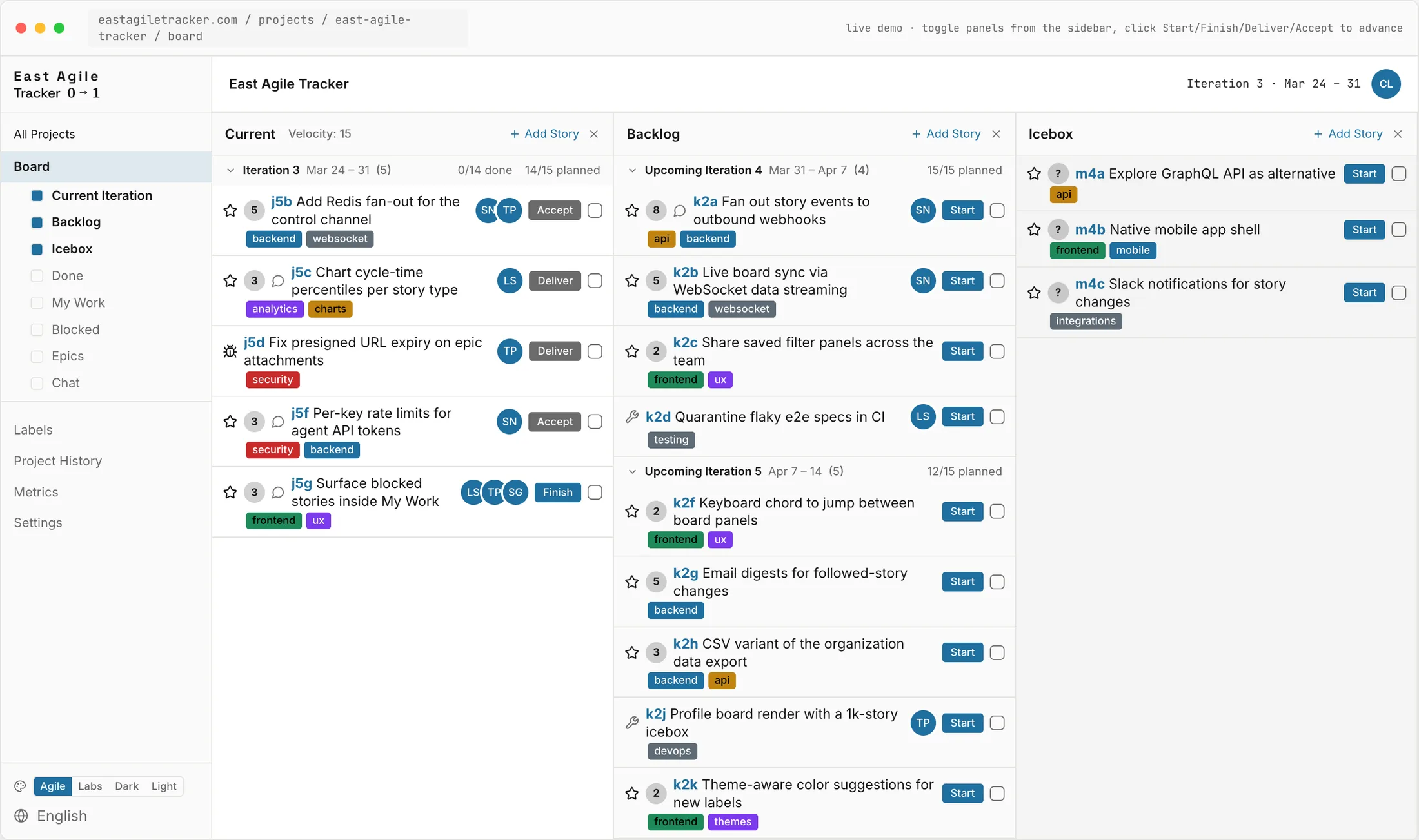
- Free foreverNo paid tier. Self-hosting on request.
- Agents are membersThey own stories, comment and move work, under their own names.
- API firstREST API, OpenAPI spec, event stream and a Claude connector.
- Leave Pivotal Tracker behindImport from Pivotal Tracker, Jira, Linear and more.
Why we built it
From Pivotal Tracker to a tracker for the AI era
- 2007
Pivotal Tracker becomes our shared workspace
Every East Agile project ran on it: user stories, points, one-week iterations, and clients accepting each story as it was delivered. It fit eXtreme Programming better than anything else.
- Sep 2024
Pivotal Tracker announces its end of life
VMware Tanzu announced that Pivotal Tracker would shut down for every customer, free and paid. Read the announcement.
- Apr 2025
Pivotal Tracker shuts down
We moved our projects and tried the trackers that were left. None kept what made Tracker work for us. By then our engineers were already pairing with AI agents, and none of those trackers treated an agent as a member of the team.
- Today
East Agile Tracker
So we built the tracker we wanted. It keeps the Pivotal way of planning, it was built API first, and it treats AI agents as members of the team. Agents get the same context people do: what to build, why, and what was already decided. It is free for everyone.
The problem
Code shows what you built. It rarely shows why.
- Decisions are made in calls, chats and pull request threads. Weeks later, nobody can find them.
- A new engineer sees the code but not the trade-offs behind it. So does a new AI agent.
- Agents only know what they can read. When the reasons are lost, they repeat old mistakes.
- Teams track the product and the flow. The reasoning is the first thing to go.
EAT keeps the why next to the work. Each story holds the request, the acceptance criteria, the discussion, the review and the final call to accept or reject. People and agents read it before they start and update it as they go.
One source of truth
The place people and agents both work from
- Write stories and acceptance criteria
- Set priorities in the backlog
- Accept or reject delivered work
- Stories and epics
- Acceptance criteria in each story
- Comments and decisions
- Reviews, blockers and linked PRs
- Full history of who did what
- Read the context before they start
- Comment, link pull requests, move stories
- Record what they decided and why
Living documentation
Kept up to date, like tests
Tests prove what the software does, and they stay current because they run on every change. EAT does the same for intent. Stories stay current because people and agents work in them every day.
- Test driven developmentTests come first, so behavior is specified before the code.
- Behavior and spec driven developmentGiven, When, Then. The spec is written in the language of the business.
- AI driven developmentAgents write code against the tests and specs. People review every change.
- East Agile TrackerHolds the specs, decisions and history that agents read and update.
Agents on the team
AI agents are members of the team, not plugins
A name, a role, a key
Each agent joins a project as a named member, with its own API key and a role: viewer, member or manager.
Every action attributed
Agent changes are recorded under the agent’s name, never a person’s. The audit log shows who did what.
People stay in charge
An agent’s role can never exceed the role of the person who created it. Revoke a key at any time; the history stays.
Built API first
A REST API with a published OpenAPI spec. One call tells an agent who it is and which moves it may make. Retries are safe.
An activity stream to follow
Agents read a stream of project events and pick up where they left off. No webhooks, no scraping.
Bring your own agent
EAT plans the work and your coding agent does it. Use Claude Code, Codex or any agent that speaks HTTP. Claude can also connect directly.
The whole cycle
From idea to accepted, on one board
- Icebox
Ideas wait here. Any member, person or agent, can add one.
- Backlog
The product owner orders the work. Iterations fill up from measured velocity.
- Started
An owner, person or agent, picks up the story and reads its context first.
- Finished
Code and tests are done, and the pull request is linked to the story.
- Delivered
The work is ready to check, against the acceptance criteria in the story.
- Accepted or rejected
The product owner decides. A rejected story is restarted; one from a past iteration returns to the top of the backlog.
By default, only features earn points, so bugs and chores show their real cost instead of inflating velocity.
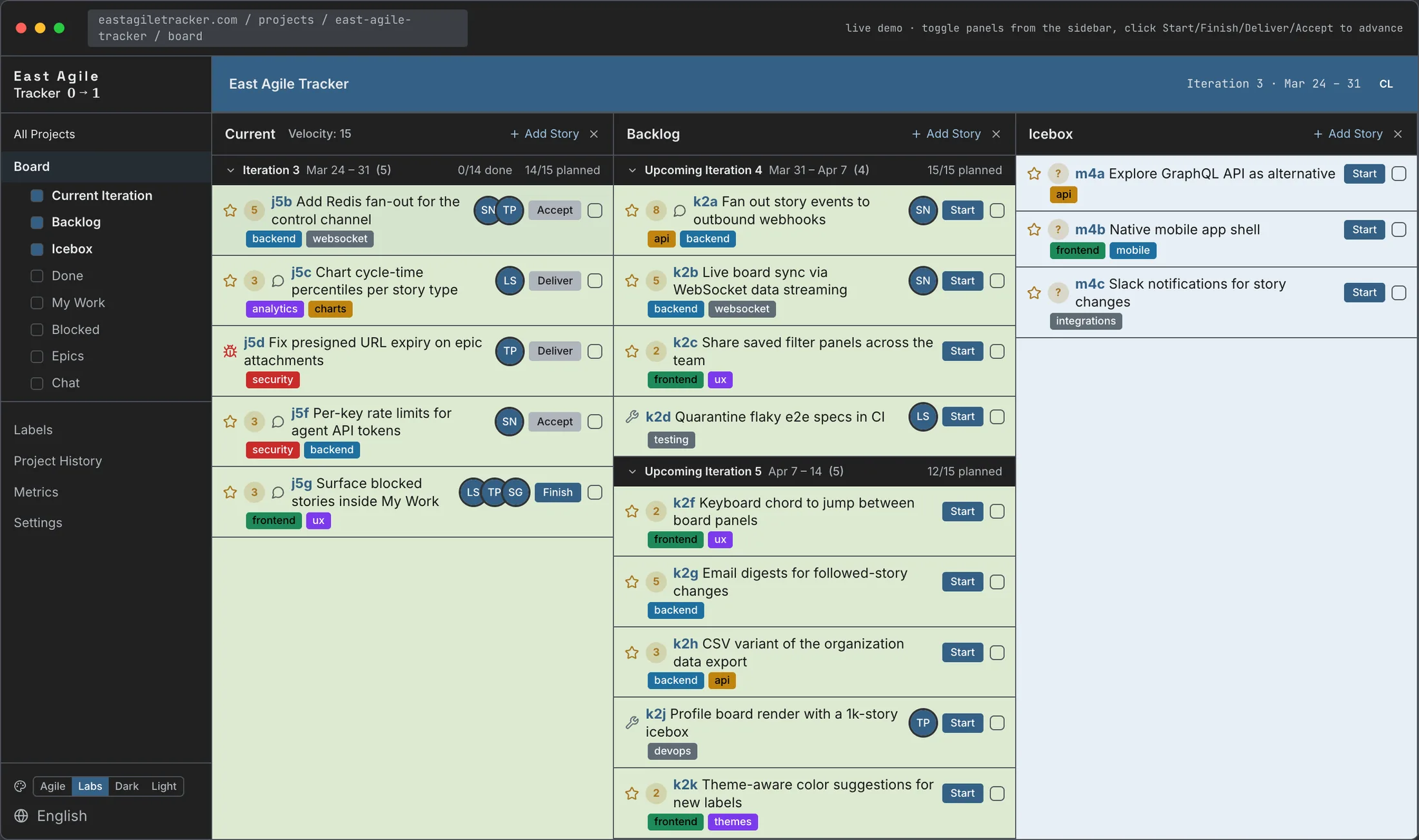
Pivotal Tracker alternative
What we kept from Pivotal Tracker
- Iterations that plan themselves from velocity.
- Points on features only, by default. Bugs and chores cost time, not credit.
- Acceptance on every story, not at a sprint demo.
- Current, Backlog and Icebox side by side.
- Import your Pivotal Tracker export, with a dry run first.
How we use it
How East Agile works in EAT
Every client project
We break the work into user stories in EAT. Clients see the board as the work happens and accept each story.
Engineers and agents, one backlog
Our engineers pair with AI agents. Both pick up stories from the same backlog and leave the same trail.
Decisions you can find later
When a client asks why something works the way it does, the answer is in the story that built it.
EAT is built in EAT
An AI agent works on the East Agile Tracker project in EAT, picking up stories that improve how agents plan and work with people.
Questions about East Agile Tracker
- What is East Agile Tracker?
- East Agile Tracker (EAT) is an agile planning tool for software teams whose members include AI agents. People and agents share one board of stories, iterations and history.
- Is East Agile Tracker free?
- Yes. There is no paid tier and no credit card. The AI model or coding agent behind an agent is billed by its own provider. Self-hosting is available on request at tracker@eastagile.com.
- Can I move my projects from Pivotal Tracker?
- Yes. EAT imports exports from Pivotal Tracker, Jira, Asana, GitLab, Shortcut, Trello, Linear and Plane, and issues from a GitHub repository. A dry run shows what will be imported before anything is written.
- Which AI agents work with it?
- Any agent that can call a REST API. Each agent key comes with ready-made setup for Anthropic, OpenAI and Google models, and Claude can connect directly through the East Agile Tracker connector. It works with coding agents such as Claude Code and Codex.
- Does East Agile Tracker touch my code?
- No. EAT plans and tracks the work. Your coding agent and your engineers change the code, and link pull requests and branches back to the story.
- How do I keep control of what agents do?
- An agent gets a role (viewer, member or manager) that can never exceed the role of the person who created it. Every action is recorded under the agent’s own name, and its key can be revoked at any time.
More in the documentation, including the API guide and how to migrate from other trackers.
Plan your next project with people and agents
Start a board for free, or let East Agile’s engineers and agents build it with you.